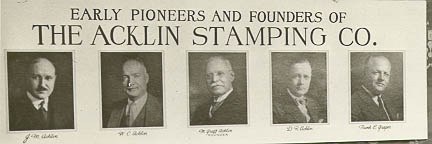
B. Grafton Acklin, Founder
Grafton Acklin was born on the banks of the Ohio River in Aberdeen, Ohio on the 30th of July, 1851. One of eight
children, Grafton attended school in Aberdeen until the age of 15 when he moved, with his family, to Toledo. Mr.
Acklin then began work in Toledo as a clerk in a wholesale grocery store, and within several years of hard work he
became one of the owners. After some time however this partnership dissolved and Grafton and his partner,
Samuel Wood, formed Acklin and Wood, a company supplying grocers with roast coffee and spices for wholesale.
By the late 1880s Grafton was considered one of the leaders of Toledo's business community. In 1896, the
Toledo Tool and Machine Company, asked Mr. Acklin to take over as the company's president. They hoped that
his energy and vision would help the company achieve new levels of success.
The Toledo Machine and Tool company had been founded in
1888 and specialized in the production of heavy metal working
equipment -- presses, shears, and formers for the shaping of
sheet iron. In 1897, the year following Grafton Acklin's
appointment to Toledo Machine and Tool's helm, he expanded
the companies business overseas, supplying British bicycle
firms with presses. In 1899 Toledo Machine and Tool introduced
a special press for the making of gas stoves, and by 1900 had
branched out into the making of planers, milling machines,
boring mills and cranes. Keeping up with technological
innovations and the growing and changing nature of the
industry, the company, under Grafton's leadership, continued to
grow until it became one of the largest manufacturing and
industrial concerns in Toledo.
By 1911, however, Grafton saw the emerging potential of the nascent automobile industry. He recognized that as
mechanized production would grow there would be an ever increasing demand for stamped metal parts and that
the potential for producing these parts would far outstrip the demand for the machines and presses to produce
these parts. He was also nearing his 60th birthday and wanted to create a business with his three sons that
would survive him.
ref..
http://www.cl.utoledo.edu/canaday/acklin/founder.html
|


PGrafton M. Acklin,
1851-1926
Press manufactured by the
Toledo Machine and Tool
Company, c. 1911
Toledo Machine and Tool company
|
Toledo, Ohio in 1911, A Backdrop
The story of Acklin Stamping, and really the
story of Toledo's metal working industry,
begins in 1911. The world was a radically
different place in those days. Brand Whitlock,
as Toledo's mayor, led a rapidly growing city
of 170,000 people. Both, the city and the
nation were on the cusp of incredible
technological change. In 1911, horses still
dominated transportation and the speed limit
was a mere 8 miles per hour. However this
was all about to change in the next several
years with the arrival of affordable
automobiles, brought to the market by a
number of companies including Toledo's
own Willys-Overland Motor Company.
Ref..
http://www.cl.utoledo.edu/canaday/acklin/back
drop.html
World War I Production.
Producing steering wheel spiders for Willys-Overland, c. 1913
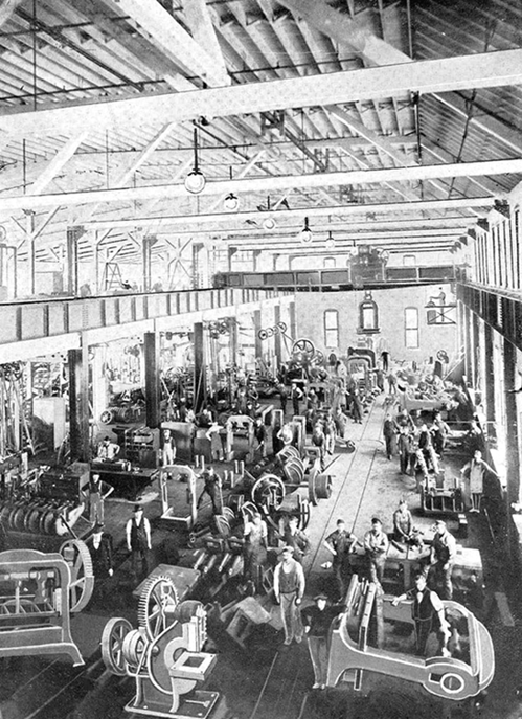
Machine Shop at Acklin's original Dorr Street
Location. Before 1925.
Acklin's Dorr Street
Plant, home since
1911, up for sale in
1925.
Grafton Acklin's business success had allowed his children to lead a fairly affluent lifestyle. The family lived in the fashionable West End
neighborhood of Toledo, a community of extravagant Victorian homes. And as was common for the sons of midwestern industrialists, all three
Acklin sons received an east-coast, Ivy League education at Cornell University. James, the oldest, was born in 1884, and graduated college in
1906. For several years following his graduation James worked with his father at the Toledo Machine and Tool Company. William, the youngest
was born in 1888, graduated Cornell in 1910 and worked as a clerk at the Northern National Bank. Donald, the middle child, born in 1886,
although nominally interested in the company's business was more interested in horses and horse racing, also serving on the state Board of
Agriculture.
So in the spring of 1911, Grafton Acklin, his sons, and Jerry Bingham, an outside investor, pulled together enough capital to found the Acklin
Stamping Company. Grafton was the company's president, while James and Donald became Acklin Stamping's vice presidents. The younger
William was named the firm's secretary and treasurer. They opened up shop on the 1100 block of Dorr Street, using presses purchased mainly
from Grafton's former company, the Toledo Machine and Tool company. It was from these beginnings that Acklin sprang.
Drawing upon his extensive industrial business experience gained through his tenure at the Toledo Machine and Tool company, Grafton Acklin's
leadership quickly proved effective. Grafton's contacts in the metal working industry as well as his strong sales and marketing ability allowed
Acklin Stamping to grow considerably in a fairly short period of time.
Picking up on the rising demand for automotive products, Acklin Stamping landed a job producing steel steering wheel spiders for automobiles.
They received production rights for an exclusive patent held by the Beck Frost Corporation and then supplied those steering wheel parts to the
Willys-Overland Company for use in a variety of automobile lines.
As a job stamping plant, Acklin Stamping could hardly expect Willys-Overland alone to support them. In order to stay competitive, Acklin Stamping
produced a wide variety of stampings for a large number of companies. At one point, the Ohio Gas Company asked Acklin Stamping to create a
display case in which they could show off canisters of their oil at gas stations. Acklin Stamping agreed and stamped several thousand of them.
After a brief trial, it was clear they weren't working out and the order dried up as quickly as it came.
This shifting of production was fairly common. Without any one major customer, Acklin Stamping stamped an assortment of products during its
early years including an order for muffler caps used in motorcycle engines. At the same time they stamped everything from pulleys used in
window sashes to metal vending machines used for dispensing Wrigley's gum and other candies. They stamped fuse socket holders and push
lawn mowers, as well as metal splicers used in the repair of trolley car poles.
In the spring of 1917, when America declared war on Germany, beginning America's involvement in the first World War, Acklin was ready. The
plant quickly shifted into the production of food containers, ammunition, and parts for Quartermaster trucks. By the time the war ended, Acklin had
125 presses, the largest of which was a 500 ton press, able to apply 500 tons of pressure to a single sheet of steel. The plant, then located in the
1600 block of Dorr Street at the corner of Woodland Avenue, shifted its production back to civilian goods.
By 1925 the company's nearly 300 employees had outgrown the facilities of the 40,000 square foot Dorr Street plant and plans were made to
build a new factory, this time on Nebraska Avenue. The new plant, built by the Toledo architectural firm of Langdon and Hohly, when constructed
was nearly 90,000 square feet in size and was connected to the New York Central railroad. The new plant allowed Acklin to employ nearly 500
employees over the next year, cementing their role as one of the largest job-stamping plants in Ohio and the nation.
Following Grafton Acklin's death in early 1926 the company remained in the Acklin families' hands. James Acklin, formerly Vice President of the
company stepped up to the presidency. James maintained the company's steady and substantial growth through the last half of the 1920s, and
with a steady hand on the company's rudder, managed to weather the storm of the Great Depression.
ref;;
http://www.cl.utoledo.edu/canaday/acklin/family.html

Drill Room at Acklin's original Dorr Street plant, before 1925. Early stamping. Notice the foot pedal driven operation. Before 1925.
Small Line Presses at Acklin's original Dorr Street
Location. Before 1925.
World War II Production http://www.cl.utoledo.edu/canaday/acklin/ww2.html
1941-1945
Picture of the Toledo machine Tool Co. I have
that is refered to in the book.. Awake! America:
Object Lessons and Warnings By William
Temple Hornaday, American Defense Society.
Books refering to the Toledo Machine
Tool Co.
ref: AwakeAmericaObjectLessonsandWarningsBy
WilliamTempleHornadayAmericanDefenseSociety book.
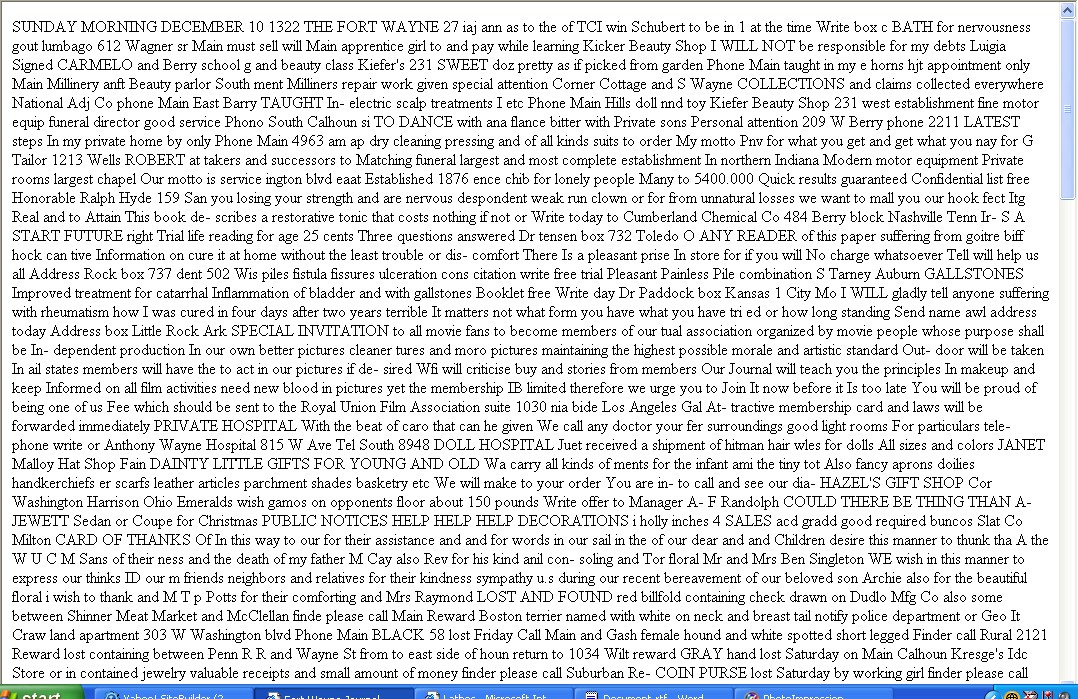
SUNDAY MORNING DECEMBER 10 1322 THE FORT WAYNE 27
HELP WANTED (ad) Experienced machinists familiar with heavy machine
tools neet work no trouble The Toledo Machine Tool Co Dorr St and N Y C
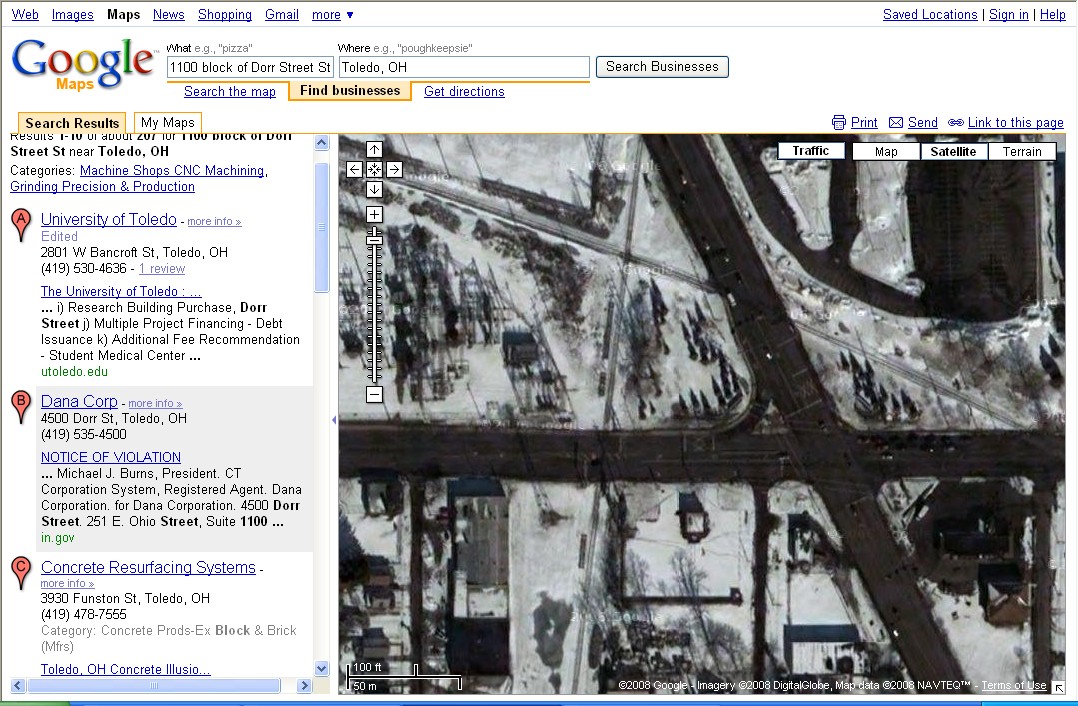
Railroad Toledo O (probably the 1100 block of Dorr Street)
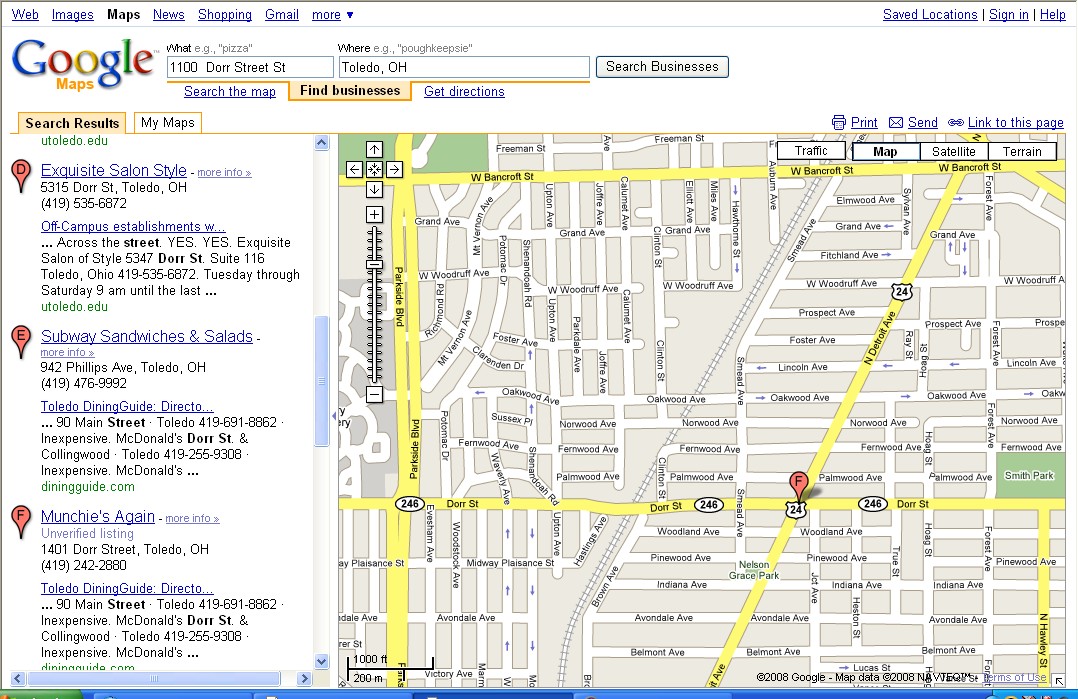
And what the site looks like now 2008.
ref:
ref: Fort Wayne Journal-Gazette (Newspaper) - December 10, 1922, Fort ..
http://www.newspaperarchive.com/newspapers1/na0008/6787070/42944532_
clean.html
http://www.lathes.co.uk/toledo/
Home Machine Tool Archive
Lathes, Millers, Shapers & Grinders
for Sale
E-MAIL tony@lathes.co.uk
TOLEDO - USA
Toledo Works
Founded in 1888 the Toledo
Machine and Tool Company (of
Toledo, Ohio, USA) at first
specialised in heavy types of metal
working equipment including
open-back, straight-side,
double-crank, punching and
horning, toggle-drawing, screw and
trimming presses, horizontal
bending machines, drop hammers,
shears and machinery for the
manufacture of pierced tinware and
stoved parts; a total of 28 different
machine types was listed in the
1909 catalog as well as an
advertised ability to construct
special sheet-metal working
machinery to a customer's special
requirements. The company was
developed under the direction of
Henry Hinde who, in 1890,
purchased an interest in the
concern when it has just 20
employees and a value of around
$30,000. In November of the same
year the company became
incorporated and Mr. Hinde was
named as the president and
general manager. In 1897 Hinde
and his brother Louis bought the
company and acquired property at
Hastings and Dorr Streets where a
factory, named by them as the
"Plant No. 1" was erected. In 1918
further expansion took place with a
new factory being built at
Westwood Avenue and Dorr Street,
a location that also became home
to a foundry at first able to produce
1200 and eventually 2,200 tons per
month. By the early 1920s the
company had over 1600
employees and were one of the
leading producers of power
presses in the United States; in
1922 a controlling interest was
purchased by a brokerage house
for $4,000,000 and by the 1930s
the firm had been absorbed into the
E.W. Bliss group. Hinde, by now a
very rich man, retired.
In 1989 Bliss were purchased by a
the Japanese Company AIDA and
today operate as AIDA-BLISS with
factories in Derby, England,
Malaya, Japan and the USA all still
producing presses and ancillary
equipment.
In 1896, just before he purchased
the company, Hinde appointed a
new president, Grafton Acklin,
under whose guidance the firm
expanded into overseas markets
with their presses to be found, for
example, in the rapidly expanding
factories of British bicycle
manufacturers. By 1900 the
company had begun the
manufacture of machine tools
including planers, boring mills and
simple lathes; they were also quick
to spot the almost unlimited market
that would shortly emerge for the
stamped parts necessary for
automobile mass production and
introduced a range of fast-working
machines especially designed for
that purpose. In 1911, when he was
nearly 60 years of age, Acklin left to
form his own company, Acklin
Stamping, a concern that, together
with his three sons, he oversaw until
his death in 1926 at the age of 74.
The lathes made by Toldeo
Machine and Tool were not of the
conventional backgeared
screwcutting type but
metal-spinning and trimming lathes,
designed to be useful to
manufacturers engaged in the
production of metal containers.
Although all the lathes below date
from 1909, they are representative
the type manufactured by the
company from around 1900 until
World War 1.
American MILLING MACHINE
Builders 1820-1920 NEW !
Steptoe Co., John, Cincinnati, OH
Toledo Milling Machine Co.,
Toledo, OH
United States Machine Tool Co.,
Cincinnati, OH
Home Machine Tool Archive
Lathes, Millers, Shapers & Grinders
for Sale
E-MAIL tony@lathes.co.uk
TOLEDO - USA
Toledo Works


The "baby" of
the Toledo
lathe the
16-inch swing
spinning lathe
weighed a
modest 600
lbs and was
designed,
according to
the makers
for: spinning,
trimming,
flanging,
curling and
wiring edges;
for burnishing
pressed,
stamped or
drawn work in
brass, copper,
tin, aluminium,
steel or black
iron.
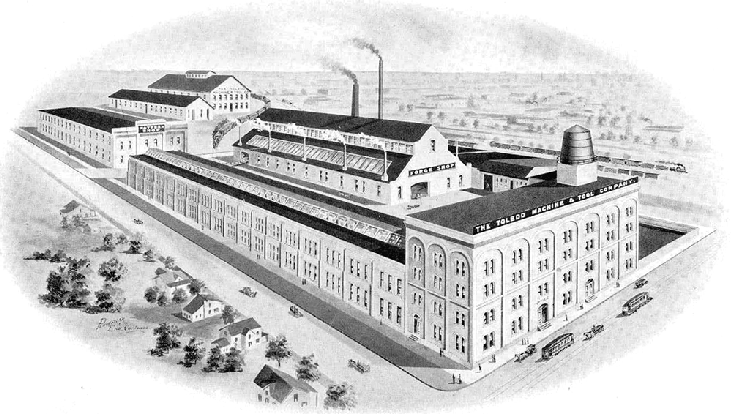
The Toledo Machine and Tool Company
works and offices in 1909
The picture that started this page for me, the building in the
1900's.Complete with horses & buggies and flywheel castings by the
RR tracks.